A small scale line is not a scaled-down factory — it is a different way of working, where manual handling replaces conveyors and the priority is getting to market rather than maximising output per hour. Done properly it is the cheapest route into soap manufacturing; done carelessly it becomes a set of machines that never quite work together.
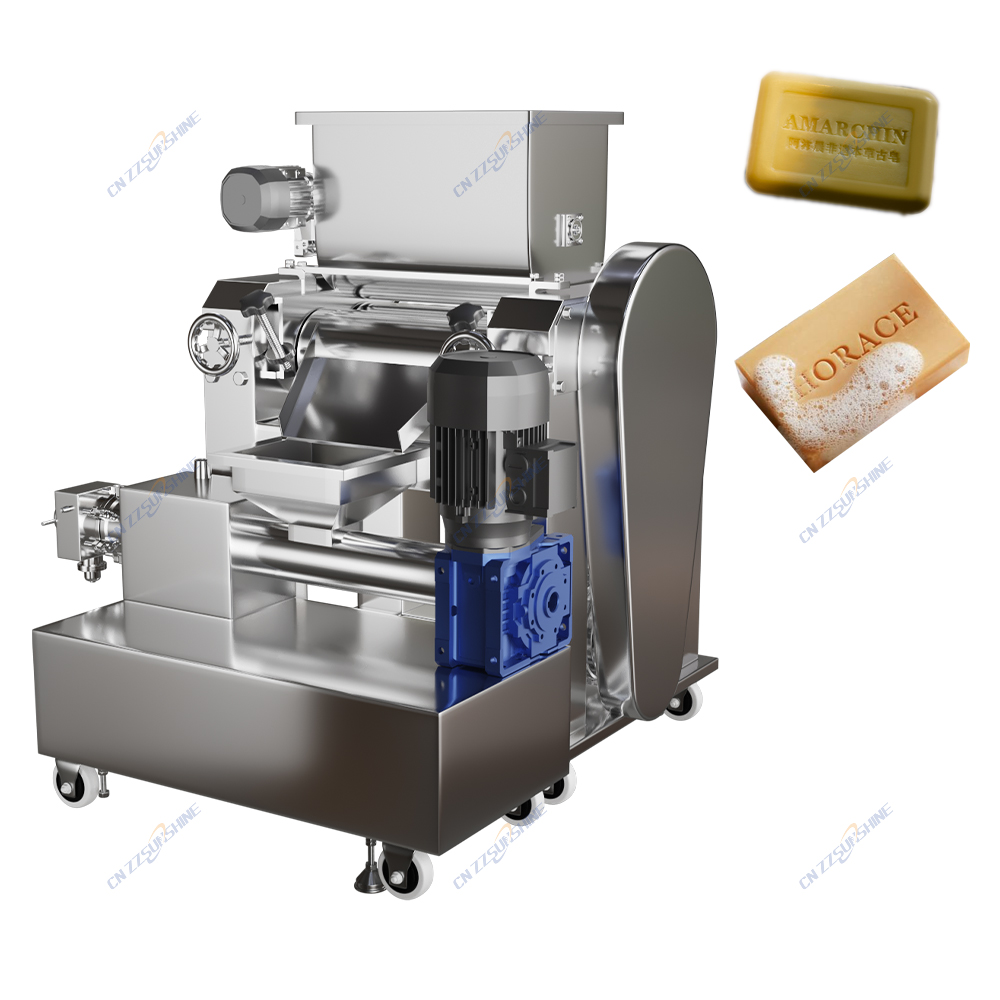
Line Composition
- Melting tank for soap base
- Mixer for fragrance and colour
- Small three roller mill
- Small plodder or extruder
- Cutter, with manual bar handling
- Manual or semi-automatic packing
Capacity and Configuration
| Product | Laundry bar soap, toilet soap, hotel soap, speciality bars |
|---|---|
| Capacity range | From 100 kg/h (about 600 – 800 kg per 8-hour shift) |
| Investment | From under US$3,000 for a minimal machine set; a fuller small line from US$8,300 |
| Typical workshop | Small industrial unit — confirm minimum dimensions with us |
| Staff | Typically 3 – 6 operators depending on automation |
| Voltage | 380V/50Hz, 415V/50Hz or 220V/60Hz |
| MOQ | 1 set |
What We Provide with the Line
Buy the machines you need now, plan for the ones you will need later
The mistake is buying a set that cannot be extended. Choose a melting tank and mixer with enough volume for your next capacity step, and a cutter and stamper with adjustment travel that covers the bar sizes you plan to sell. Then add the mill, the wrapper and the conveyors as volume grows, without replacing what you already own.
Manual handling is a legitimate choice at this scale
Conveyors and automatic transfer exist to remove labour cost and to keep a high-speed line fed. At 100–300 kg/h, manual transfer is often cheaper overall and far more flexible when the layout is not perfect. Plan the space and working heights so conveyors can be added when they start to pay.
Do not skip the mill
The single most common way to spoil a small soap business is to skip milling and sell a coarse, streaky bar. Milling is what makes a cheap bar look acceptable next to a competitor’s. If budget is tight, start with fewer machines but keep the mill in the set.
Get the workshop conditions right first
Concrete floor that can be washed, drainage, a water supply, three-phase power, ventilation, and somewhere dry to store soap base. Soap base absorbs moisture. A leaking roof in the storage area will cost you more product in a year than the machine set costs once.
Learn on your own machine, with your own formulation
Budget time for commissioning and training, and keep a batch record from the first day. On a small line, the operator’s experience is the most valuable asset in the business, and it only accumulates if you record what you did.
Price, MOQ and Lead Time
A minimal machine set for a small plant starts from under US$3,000; a fuller small scale line from US$8,300 per set. Tell us your target output and the products you want to make and we will propose the smallest set that gets you there, then show you what the next step up would cost.
MOQ 1 set. Layout drawings, installation guidance and operator training are included.
Get a Quotation for This Machine
Tell us your target capacity, the soap type you produce and your country. Our engineers reply within 12 working hours with a configuration proposal and FOB price.
Send Your Requirement Download the full specification catalogue
Frequently Asked Questions
How much does it cost to start a small soap business?
Machinery is only one part of it. Plan for the machine set, sea freight and inland transport, installation and commissioning, a starting stock of soap base and packaging, a small workshop deposit and working capital for the first production runs. We will give you the machinery figure and a machine list so you can build the rest of the budget yourself with real numbers.
What is the smallest output that makes sense?
Around 100 kg/h is a practical floor, which on one shift is roughly 600–800 kg per day. Below that the machinery still costs about the same, so it is usually better to under-run a slightly larger machine than to buy a smaller one.
How long until I can start producing?
Manufacturing typically takes 15–25 days, sea freight another 3–5 weeks depending on destination, then around a week for installation and training. Plan on roughly two months from order to first commercial production.
Can you help with the formulation?
We advise on process settings: temperatures, moisture targets, milling gap and stamping conditions. Formulation itself depends on your local raw materials and market, and we will tell you which process parameters your formulation needs once you have it.