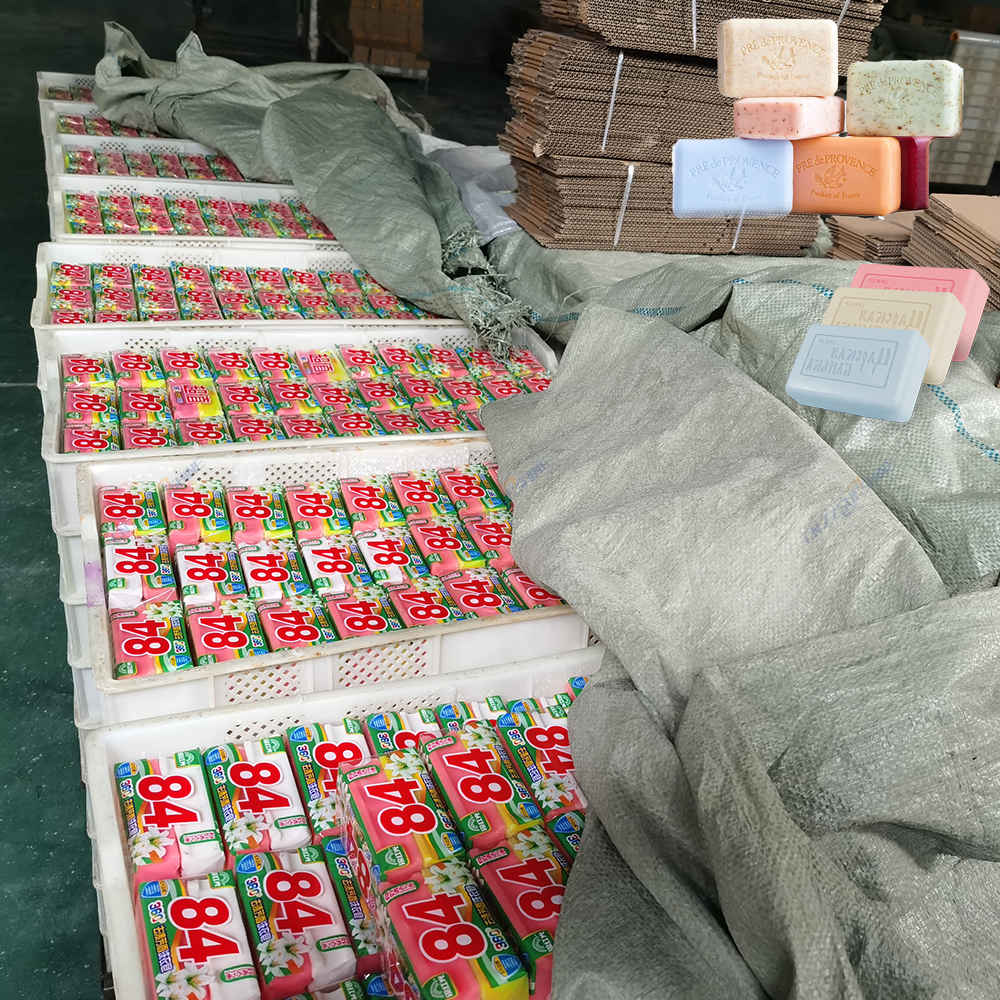
Laundry bar soap is the highest-volume product in most African, South Asian and Latin American markets and the most price-sensitive, which means the whole project is decided by cost per tonne. This line is configured for that — high output, durable working parts, and a minimum of machines doing work that is not essential to the product.
Line Composition
- Melting tank and mixer for soap base preparation
- Three roller mill for milling and homogenising
- Vacuum plodder for refining and extrusion
- Cutter for billet and bar cutting
- Optional stamping for branded bars
- Wrapping, or manual packing for unbranded bulk bars
Capacity and Configuration
| Product | Laundry bar soap, washing bars, multi-purpose bar |
|---|---|
| Capacity range | 100 – 3,000 kg/h (confirm your band) |
| Typical bar size | 150 – 400 g |
| Main stages | Melting, mixing, chipping, milling, plodding, cutting, optional stamping and wrapping |
| Feedstock | Purchased soap noodles, or in-house neat soap from saponification |
| Line price | Complete automatic finishing line from US$8,300 per set; smaller configurations from under US$3,000 |
| Typical voltage | 380V/50Hz, 415V/50Hz, 220V/60Hz or 440V/60Hz — built to your supply |
| MOQ | 1 set |
What We Provide with the Line
Keep the cost per tonne down
Laundry soap sells on price, so the plant should not carry cost it does not need. In most projects that means buying soap noodles rather than saponifying, using a solid single-stage rather than a duplex plodder at the lower end, and hand-packing rather than buying a wrapper until volume makes the wrapper pay for itself. We will tell you which machines to defer and in what order to add them.
Bar hardness is the quality complaint you will actually get
A laundry bar that turns soft or mushy in the hand generates returns and loses shelf space. Hardness comes from moisture content and formulation. Get the drying and milling stages right and the problem disappears; skip them and no amount of pressing will fix it. Send us your formulation and we will tell you which moisture target to aim for.
Plan for local freight and spares, not just the machine price
Inland transport from the port, offloading equipment, spare blades, spare screws and a maintenance regime matter more on a laundry soap project than on any other, because the margin per tonne is thin. Build the spare parts into the initial order — shipping one blade later costs more than the blade.
Start at the capacity you expect to reach
Laundry soap demand grows quickly once you are in distribution, and the cheapest way to add capacity is a second shift on a machine that is already big enough. Ask us to price the configuration one size up as well, so you can see what the next step costs before you commit.
Price, MOQ and Lead Time
A complete automatic laundry bar soap finishing line is currently listed from US$8,300 per set. Smaller configurations and single machines start from under US$3,000. Send your target output in kg/h and the soap type and we will return a machine list with individual prices.
MOQ 1 set. Layout drawings, installation guidance and operator training are included.
Get a Quotation for This Machine
Tell us your target capacity, the soap type you produce and your country. Our engineers reply within 12 working hours with a configuration proposal and FOB price.
Send Your Requirement Download the full specification catalogue
Frequently Asked Questions
What capacity do I need to supply a regional market?
Work from your intended sales volume. A 300 kg/h line on one 8-hour shift produces about 2.4 tonnes per day, roughly 12,000 bars of 200 g. Tell us the volume you plan to sell and we will size the line to match it.
Do I need a stamping machine for laundry soap?
Only if you are building a brand. Unbranded bulk bars normally go straight from the cutter to packing. Adding a stamping machine later is straightforward, so it is a reasonable step to defer.
Can the line make both laundry soap and toilet soap?
The machinery is largely the same, but laundry and toilet soap differ in formulation, moisture target and finishing. Most factories that make both run them in campaigns on one line rather than simultaneously.
What is the smallest viable plant?
A mini plant from 100 kg/h is the usual starting point: melting tank, mixer, mill, plodder and cutter, with manual packing. That is enough to enter the market and to learn the process before investing in automation.