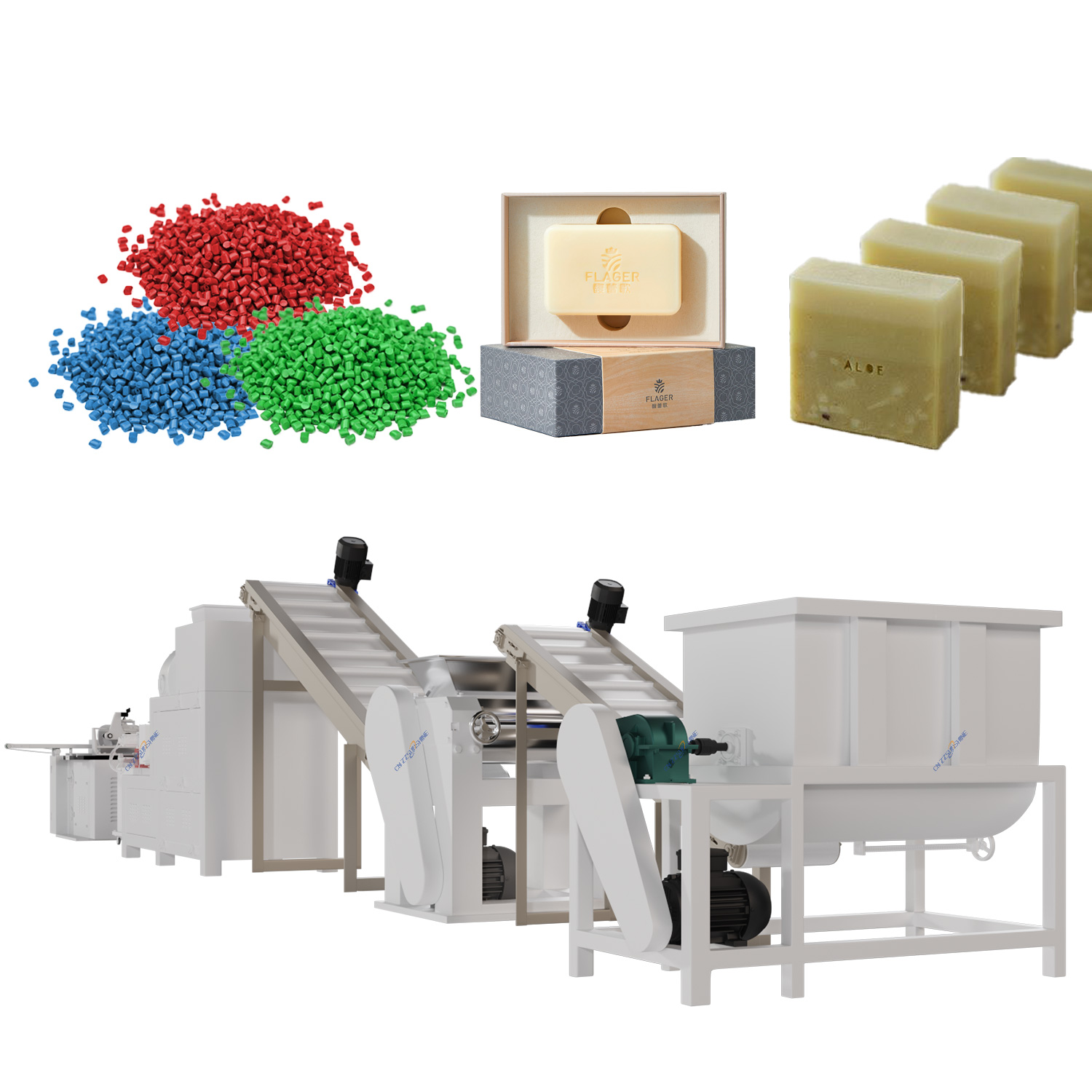
The process is the same in a three-machine workshop and in a fully automatic factory; what changes is how much is done by machine. This page walks through each stage, what it is for, and what goes wrong if it is skipped.
Stage 1 — Soap base: noodles or saponification
You either buy soap noodles, or you make neat soap in-house by reacting oils or fats with caustic soda. Noodles give you a faster, cheaper and much simpler start, and for most plants below about 1,000 kg/h they are the right choice. Saponification only pays off at higher volume or where local oils are cheap. Note that noodles must be stored dry — they absorb moisture from the air and that changes your process settings.
Stage 2 — Melting
Soap base is melted in a jacketed, insulated vessel with a stirrer, and held at working temperature. Stirring is essential: without it the material touching the hot wall scorches while the centre is still solid, and scorched soap cannot be recovered. Keep the hold time short, because soap held hot for a long time darkens and loses fragrance.
Stage 3 — Mixing and dosing additives
The mixer is where your product is decided. Additives — fragrance, colour, whitener, glycerine, preservative, fillers — are dosed and blended in. Weigh everything; do not measure by volume. Record the batch: date, batch number, material weights, temperatures and any deviation. That record is what allows you to find the cause of a problem instead of guessing.
Stage 4 — Chipping
The mixed soap is cooled and broken into chips small enough for the mill to grip. On very small outputs this is sometimes done by hand, but manual chipping is inconsistent and it slows the mill, and an overloaded mill is one of the commonest causes of roller damage.
Stage 5 — Milling
A three roller mill grinds the chips into a fine, uniform mass. This is the stage that most directly determines whether your bar looks acceptable next to a competitor’s: it distributes colour, breaks down lumps and gives the smooth surface. Roller cooling matters, because a hot mill cannot be run at a fine gap; the soap sticks and the temperature runs away.
Stage 6 — Vacuum extrusion (plodding)
The milled mass contains air. A vacuum plodder compacts it under vacuum and extrudes a dense, solid billet. Skip the vacuum and the air stays inside, showing up as surface pinholes after drying, inconsistent bar weight and cracking during stamping. For plain unbranded bars this may be tolerable; for anything branded it is not.
Stage 7 — Cutting
The billet is cut first to length and then into individual bars. Cut accuracy is weight accuracy: on a 200 g bar a small cut error is a few grams, but on a small guest bar the same error is a visible percentage. If you sell small bars, specify cut accuracy rather than capacity.
Stage 8 — Stamping (optional)
Unbranded laundry bars often skip stamping. If you are building a brand, a press forms the final shape and presses the logo. Bar temperature decides the result: too warm and it smears, too cold and the edge cracks. Treat the stamping temperature as a commissioning task and record the setting that works.
Stage 9 — Cooling, drying and packing
The bar has to reach its final moisture and hardness before it is packed, otherwise it shrinks and warps inside the wrapper and the customer sees a defective product. Moisture control in laundry soap matters especially, because a bar that stays soft in use generates complaints and returns. Pack by machine if you are selling retail, by hand if you are selling bulk and volume is low.
The two measurements that predict your quality complaints
Track bar weight per shift and bar moisture per batch. Nearly every customer complaint about laundry soap — too soft, does not last, crumbles, weighs light — traces back to one of those two numbers drifting. Both are cheap to measure, and recording them turns a mystery into a maintenance task.
Get a Quotation for This Machine
Tell us your target capacity, the soap type you produce and your country. Our engineers reply within 12 working hours with a configuration proposal and FOB price.
Send Your Requirement
Download the full specification catalogue
Frequently Asked Questions
Can I skip milling and go straight from mixing to extrusion?
Physically yes, commercially usually not. Unmilled soap produces a coarse, streaky bar with uneven colour, and it is the most common reason a new brand fails to hold shelf space next to an established competitor.
How much moisture should laundry soap have?
It depends on your formulation and your market, and there is no single number that is right everywhere. Aim to fix a target for your product, measure it every batch and keep it inside a defined range. We will advise on which process settings control it for your recipe.