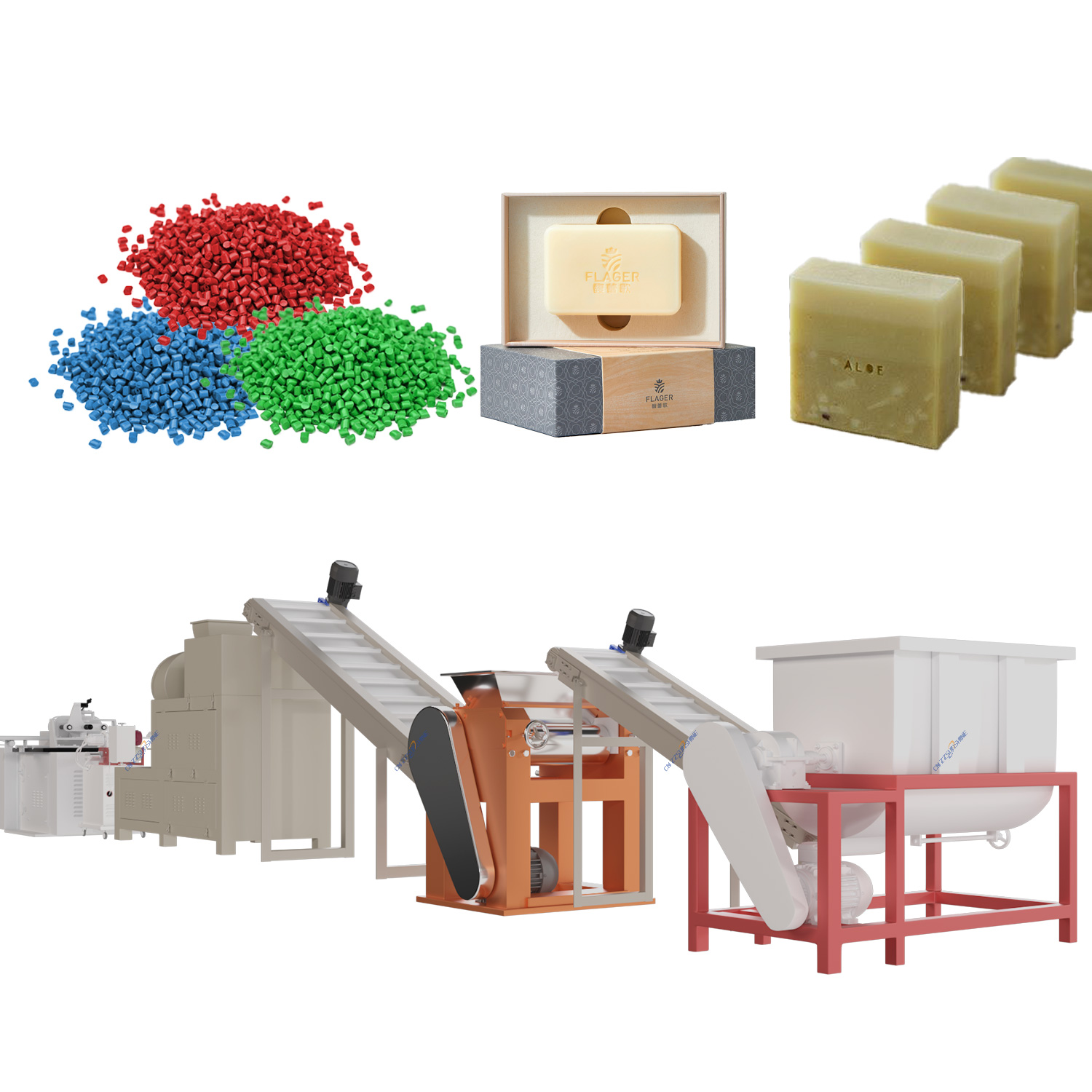
Where your soap comes from decides a large share of your investment and almost all of your raw material cost. The three routes are buying noodles, buying melt-and-pour base, and making your own base by saponification.
Soap noodles
Noodles are the standard industrial soap base: dried, milled soap in noodle form, sold by the tonne. You melt them, add your fragrance and colour, mill and finish. This is the normal route for bar soap factories and the right starting point for most plants below roughly 1,000 kg/h. Investment is low, there is no caustic handling, and the process is predictable because the base is consistent. Your margin depends on the price you pay for noodles and the price you get for the bar.
Melt-and-pour base
Melt-and-pour base is a ready-to-use soap, usually glycerine-based, supplied in blocks for small producers and craft soap makers. It needs no milling and often no extrusion: you melt it, add colour and fragrance, and pour or mould it. It is the simplest possible route to a finished bar, with the lowest equipment cost. The trade-off is a much higher raw material cost per kilogram and limited ability to vary the formulation, which makes it suitable for speciality and craft products rather than for competing on price in laundry or commodity toilet soap.
In-house saponification
You react oils or fats with caustic soda to produce neat soap and glycerine. Raw material cost per tonne is the lowest of the three routes, and the glycerine can be recovered and sold. Against that: high capital cost, caustic handling and safety requirements, a chemistry process to control, and glycerine recovery plant if you want the by-product value. This route only pays back above a certain volume and where oils or fats are cheaply available locally. In practice that means roughly 1,000 kg/h of finished soap or more.
How to decide
- Under about 300 kg/h: buy noodles. Saponification cannot be justified at this scale.
- 300–1,000 kg/h: buy noodles, unless local oils or fats are exceptionally cheap and you already have process experience.
- Above about 1,000 kg/h: run the numbers properly on in-house saponification, including glycerine recovery and the cost of handling caustic soda safely.
- Craft, speciality or very small volume: melt-and-pour base is often the right answer even though the material costs more, because the equipment and the process are so much simpler.
What changes in the plant if you switch
Moving from bought noodles to saponification is not a machine swap — it is a different plant, with reactors, caustic storage and dosing, lye handling, glycerine recovery and a very different skill set. Moving from melt-and-pour to noodles requires adding milling and extrusion, because melt-and-pour does not have to be milled but noodle-based soap does. Plan the transition as a project, not as an upgrade.
The comparison you should actually run
Take the landed price of noodles per tonne in your country, your expected selling price per tonne of finished soap, and your volume. Multiply the difference by your annual tonnage and compare it with the capital, operating and compliance cost of the saponification plant. Send us your noodle price, your volume and the oil price you can obtain, and we will help you frame that comparison with real numbers rather than a rule of thumb.
Get a Quotation for This Machine
Tell us your target capacity, the soap type you produce and your country. Our engineers reply within 12 working hours with a configuration proposal and FOB price.
Send Your Requirement
Download the full specification catalogue
Frequently Asked Questions
Can I switch from noodles to saponification later?
Yes, but it is a second project rather than an upgrade, and the two usually run side by side for a period while the new plant is commissioned. Plan the space and the utilities for it when you lay out the plant the first time.
Is noodle-based soap lower quality than saponified soap?
Not inherently. Quality depends far more on the formulation, the milling, the vacuum extrusion and the moisture control than on whether the base was bought or made. Many premium bars are made from purchased base.