

The Power of Automation: Streamlining Soap Production with Modern Machinery
The soap industry, catering to diverse markets from laundry bars to premium beauty soaps, demands efficiency, consistency, and scalability. Achieving these goals increasingly relies on sophisticated machinery designed to handle every stage of the production process. At the heart of modern soap manufacturing lies the concept of the automatic soap production line, integrating specialized equipment to transform raw materials into finished, market-ready products with minimal manual intervention.
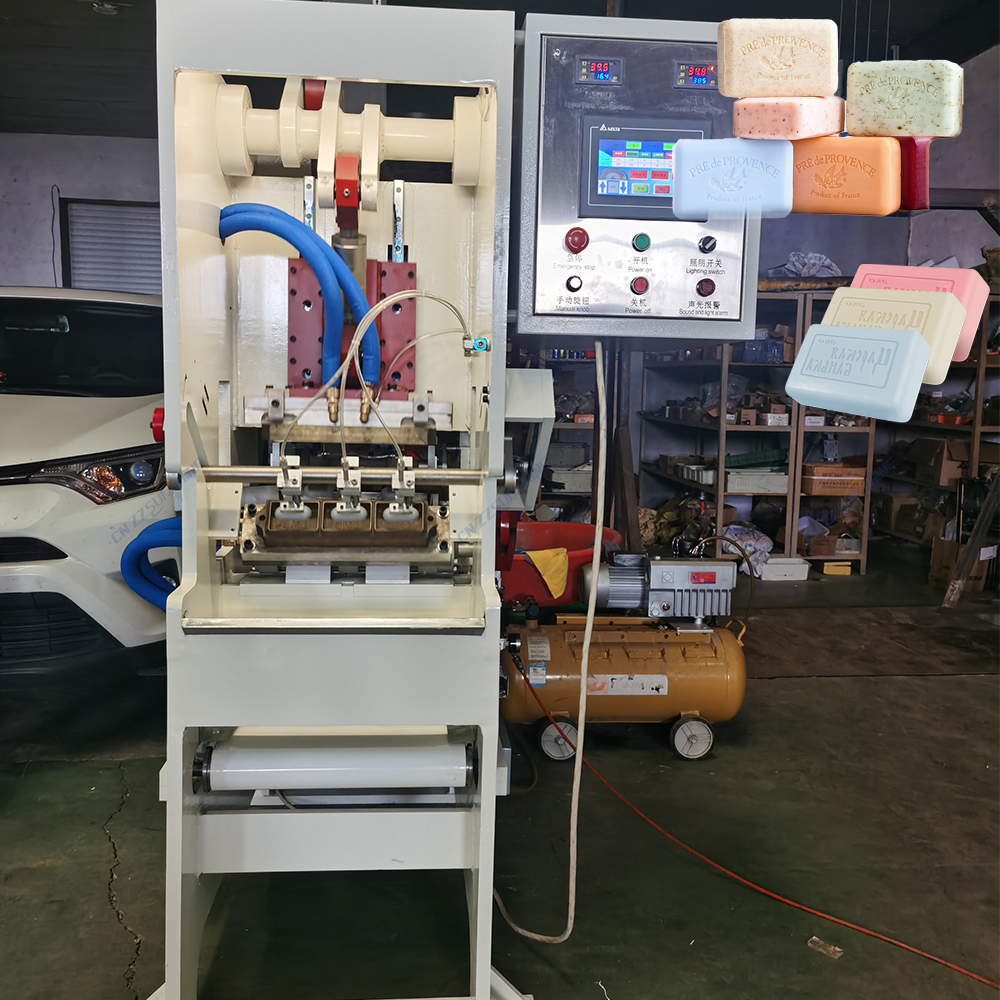
Central to many modern facilities is the Fully Automatic Soap Printer/Soap Forming Machine With Attached Mold. This machine exemplifies efficiency, automating the critical steps of forming and shaping the soap mass. It receives homogenized soap noodles from preceding stages and precisely extrudes them through an attached mold, creating continuous, uniformly shaped soap bars. This eliminates the variability often associated with manual forming and significantly speeds up production. The attached mold feature ensures consistent bar dimensions and weight, crucial for quality control and packaging efficiency.
Before reaching the printer, the soap mass undergoes essential preparation. A robust soap mixer or mixing machine combines fats, oils, caustic soda, and additives to initiate saponification. The resulting paste is then refined using equipment like an OEM three roller grinding mill to ensure a smooth texture. This refined paste is transformed into noodles via a soap plodder machine for bar soap – often a vacuum plodder which removes air pockets, resulting in a denser, higher-quality bar soap. These noodles are then fed into the forming machine.
Following extrusion and forming, the continuous soap log is cut into individual bars. This is where precision cutting equipment comes in, ranging from automatic block cutter machines to pneumatic cutting machines or electronic cutting machines, depending on the line’s automation level and required throughput. The cut bars then proceed to finishing stages. For toilet soaps, a dedicated toilet soap finishing line might include cooling tunnels, soap stamping machines for branding, and polishing units. Finally, film packaging machines efficiently wrap the bars for distribution.
Whether setting up a large-scale laundry bar soap production line, a specialized beauty soap making line, or even a compact mini soap production line, the choice of machinery dictates output quality and operational cost. Integrating a fully automatic soap printer/soap forming machine with attached mold represents a significant step towards maximizing efficiency, ensuring consistent product quality, and enhancing the overall competitiveness of your soap making plant. Investing in the right soap making machine technology, from mixing and plodding to cutting, stamping, and packaging, is fundamental to thriving in the competitive soap manufacturing landscape.