Crafting Quality Soap on a Smaller Scale: Your Guide to Essential Production Line Machinery
Starting or expanding a small soap manufacturing business requires smart investments. You need equipment that’s efficient, reliable, and scaled appropriately for your production volume and budget. That’s where a well-designed small line soap making saponification machinery setup comes in. While often referred to as “saponification machinery,” it’s important to clarify that for many small businesses, especially those starting out, the process often begins with pre-made soap noodles or bases. However, the core machinery needed to transform these raw materials into finished bars remains crucial.
Why a Dedicated Small Production Line Makes Sense
For small businesses aiming for consistent quality and branding, relying entirely on handcrafted methods isn’t always scalable. A dedicated soap making production line, even a compact mini soap production line, provides significant advantages:
Consistency: Machines ensure uniform mixing, extrusion, cutting, and stamping, resulting in professional-looking bars every time.
Efficiency: Automation, even semi-automatic, speeds up production compared to manual methods, boosting output.
Labor Savings: Reduces the physical strain and time required for repetitive tasks like cutting and stamping.
Scalability: A small line provides a solid foundation that can potentially grow with your business.
Core Components of a Small Soap Production Line
A typical line for producing bar soap, whether laundry bar soap production line or toilet soap finishing line, involves several key machines working in sequence:
1. Mixing: The foundation starts with a robust soap mixer or mixing machine. This blends soap noodles (often pre-saponified) with fragrances, colors, additives, and any necessary moisturizers or exfoliants thoroughly and homogeneously. For higher quality and smoother texture, especially in beauty soap making line products, an OEM three roller grinding mill might be incorporated to refine the soap mass further before extrusion.
2. Plodding/Extrusion: This is where the mixed soap mass is transformed. A soap plodder machine for bar soap is central. It compresses the soap, removes air bubbles (especially crucial in a Vacuum plodder), and extrudes it through a die to form a continuous, solid log of soap. This step is vital for achieving the desired density and texture in the final bar. The soap plodder is arguably the heart of the bar production process.
3. Cutting: The continuous soap log then moves to cutting. Options range from manual cutting machines (more labor-intensive) to highly efficient automatic block cutter machines. Electric washing soap cutters, pneumatic cutting machines, or electronic cutting machines offer precision and speed, slicing the log into individual bar-sized pieces. A custom soap cutting machine allows for flexibility in bar length.
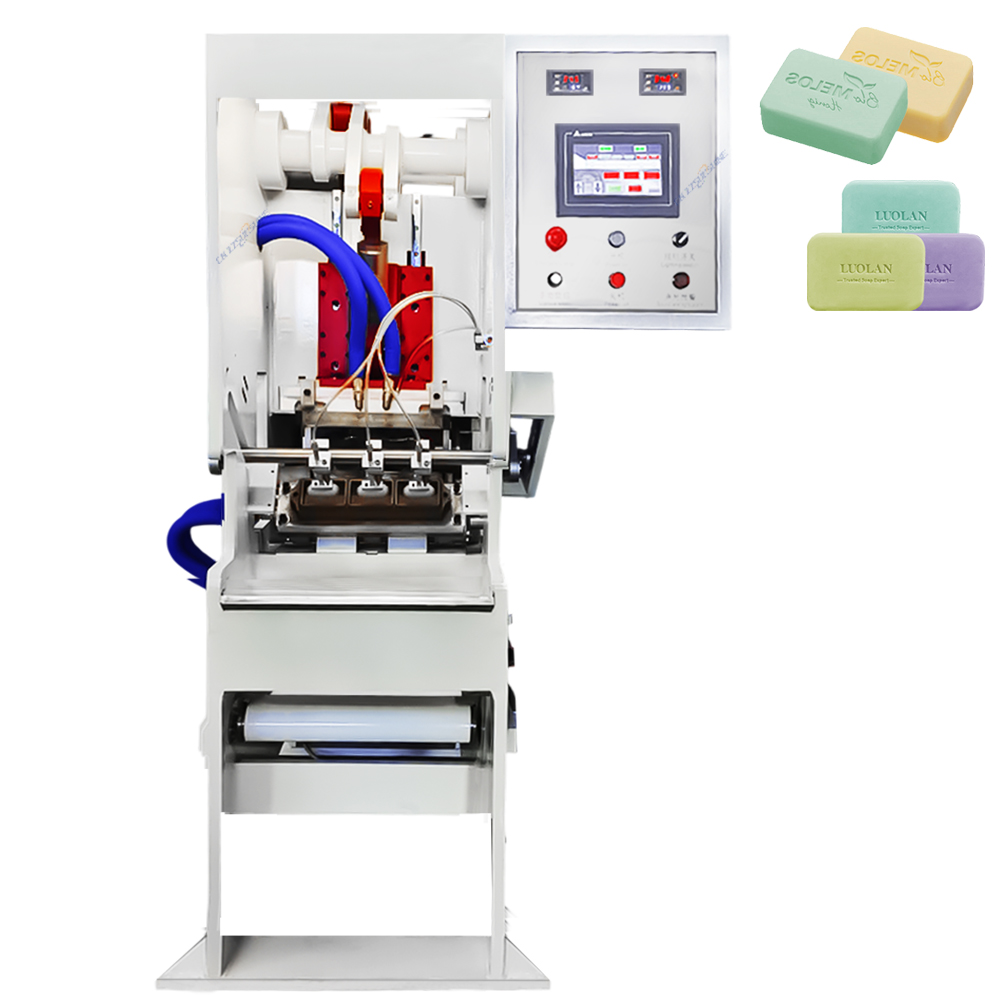
4. Stamping and Finishing: The cut bars proceed to stamping. An Automatic Soap Stamping Machine or Semi-automatic Printer imprints your brand logo, design, or product information onto the soap surface. This step adds significant branding value. Finally, bars may be cooled and then packaged. While smaller lines might handle packaging manually, a Film Packaging Machine can automate wrapping for higher volumes.
Choosing the Right Machinery for Your Small Business
Selecting equipment involves balancing several factors:
Production Volume: Match the machine capacity (kg/hour) to your current and near-future needs.
Product Type: Are you making simple laundry bars, intricate beauty soaps, or perhaps also considering Washing Liquid Production Equipment? The complexity dictates machinery features.
Automation Level: Semi-automatic machines offer a good middle ground, reducing labor but requiring some operator involvement. Automatic soap production line components maximize output with minimal manual input but come at a higher cost.
Budget: Prioritize essential core machines like the soap mixer, soap plodder, and a reliable cutter. You can add stamping and packaging automation later.
Space: A mini soap production line is designed to fit smaller workshop footprints.
Investing in Your Soap Making Future
Implementing a tailored factory small line soap making saponification machinery setup is a strategic move for ambitious small soap businesses. By understanding the roles of key equipment like the soap plodder machine, automatic block cutter machine, and soap mixer, you can build an efficient, cost-effective production line. This investment empowers you to create high-quality, consistently branded soap bars – whether for laundry, bath, or beauty – efficiently and professionally, laying the groundwork for sustainable growth.